Traceability
Why compounded medication isn't mass-produced — and what that means for consistency
Compounded medication is made in small batches to a physician's order, not mass-produced — which is why consistency comes from batch-level testing, not brand-wide promises.
29 September 2026
Two different manufacturing models
Mass-produced medication is made once, at scale, in a fixed formula, then distributed to millions of patients over months or years. Every box that comes off that line is meant to be chemically identical to the last, and the regulatory system around it — from manufacturing approval to batch recalls — is built around that assumption of sameness.
Compounded medication doesn't work that way. It's prepared in small batches, against a specific physician's order, by a pharmacy licensed to do that preparation. The formulation may be adjusted for an individual patient's clinical picture — a different strength, a different delivery form, a combination that isn't commercially available. That's the entire reason compounding exists as a regulated category: to fill a gap that mass production can't, under the supervision of a prescriber and a pharmacist rather than a factory line.
Why this changes what "consistency" means
Because compounding happens in batches rather than as one continuous production run, consistency isn't something you can claim once for an entire product line. It has to be demonstrated batch by batch. A licensed pharmacy partner tests each batch — checking things like identity, strength, and purity of the preparation — and keeps documentation tied to that specific batch, not to the compound as a general concept.
This is a structural difference, not a marketing one. A single, sweeping claim like "this product is tested" doesn't mean much in a compounding context, because the thing being evaluated is the batch in front of you, prepared on a given date, from a given set of raw materials. The right question isn't "is this compound safe" — it's "what does the documentation for this specific batch show."
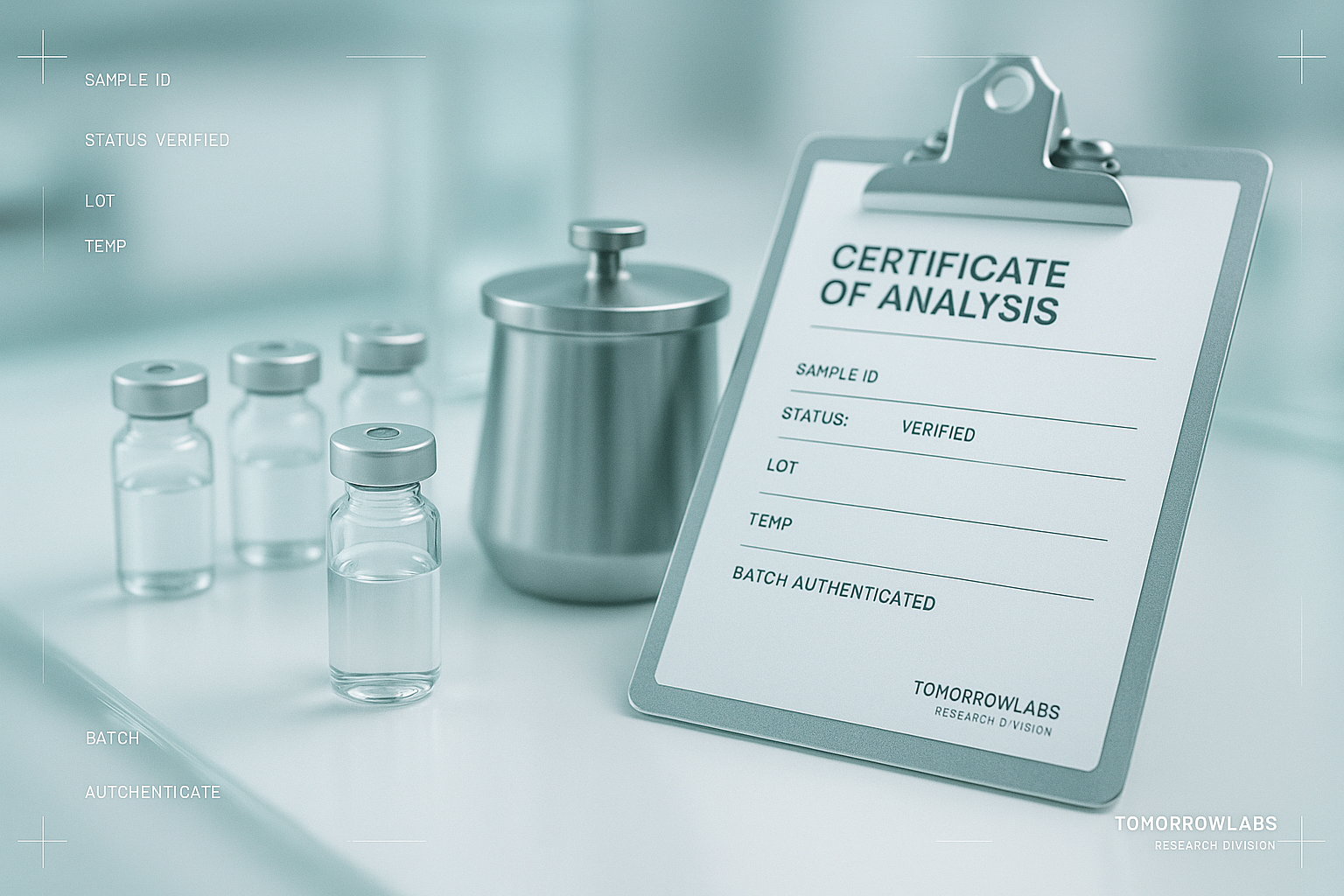
A Certificate of Analysis is analytical evidence about the sample tested — not a claim of clinical safety, efficacy, or regulatory approval.
Where this matters most: comparing to unregulated sources
This distinction is exactly what disappears when medication is sourced from a Telegram seller or an unregistered online shop. There's no prescriber attached to the order, no licensed pharmacy preparing it to a documented process, and — critically — no batch record to point to at all. Claims about purity or testing in that context are just words attached to a package, with nothing behind them that a patient can verify.
In a properly regulated compounding pathway, the opposite is true: there's a physician who evaluated the patient and wrote the order, a pharmacy that is licensed to prepare it and accountable for how it's made, and batch documentation that exists whether or not a patient ever asks to see it. None of that guarantees an outcome — no medication documentation does — but it means the preparation itself is traceable to a specific process, a specific pharmacy, and a specific date, rather than to nothing at all.
What this means for you as a patient
When you're comparing a compounding pathway to an unregulated source, the relevant question isn't which one sounds more convincing. It's which one has a person and a process you can name — a physician who reviewed your case, a pharmacy licensed to prepare the order, and a batch record that exists independent of any claim made in an advertisement.
If you're weighing whether a compounded approach is appropriate for your situation, that conversation starts with a clinical intake and a review by a licensed physician — not with a product page. Tomorrow Labs' assessment process is built to get you to that conversation directly.